
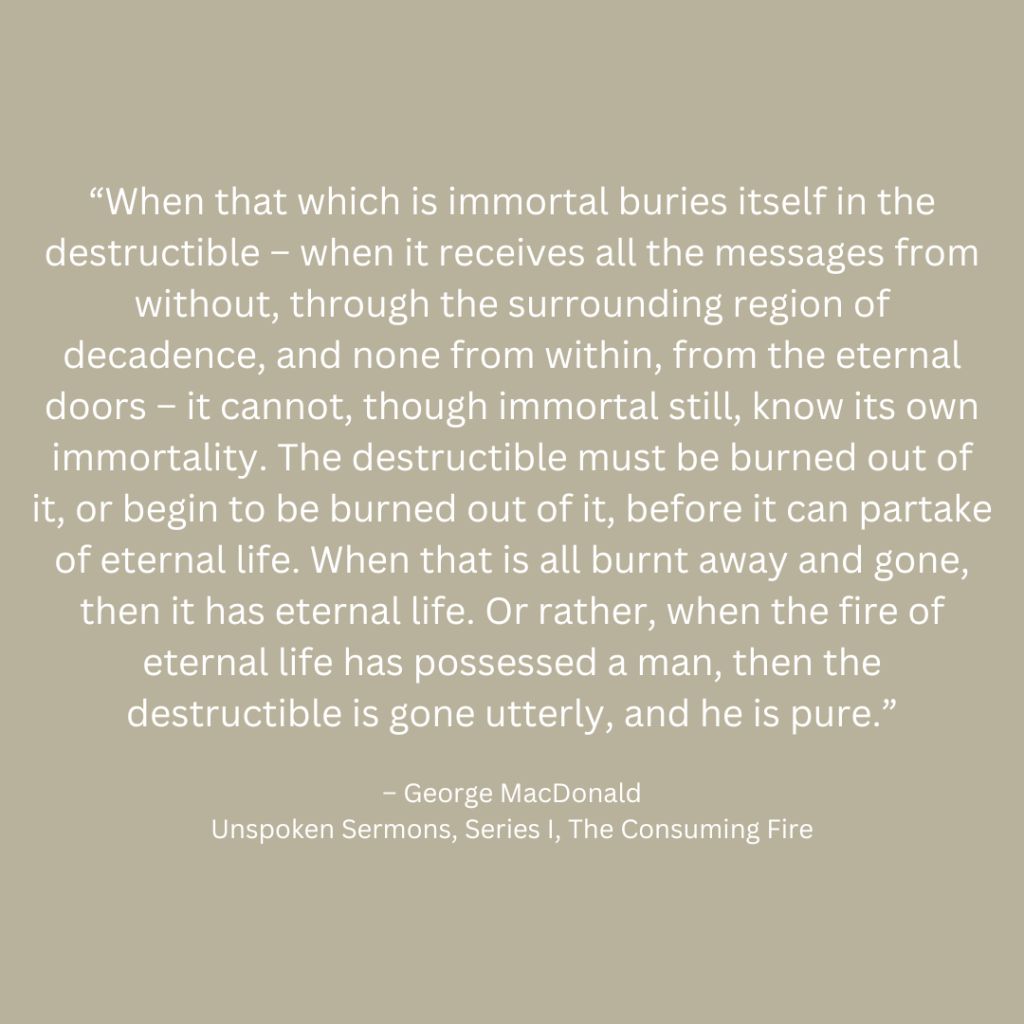
George MacDonald’s sentiment quoted above articulates better than I can the premise of this blog. To some, religion is a list of dos and don’ts as a means to an end, with The Law as a guide to achieving heaven. I, however, maintain, as did George, that this side of our mortality is a pathway of preparation for the eternal. Our life trials are the consuming fire that exposes the dross of our sinful self and skims it from the surface, purifying us through the process. In the end, I truly believe we will come face to face with our Heavenly Father and answer, not for our actions in the flesh, but for our heart’s condition, the motivations behind our actions, which is why we are warned over and over throughout the scriptures to guard our hearts “above all else” because our actions are a byproduct of the condition of our heart (Proverbs 4:23).
One of the most influential spiritual mentors in my life once shared his observations revealed through many of his counseling sessions with varying people; there is this underlying idea that as Christians we go through our days as if there is a balancing scale based on our outward actions. We think that if we perform enough good deeds to outweigh the bad, then the scale will decide our eternal fate. Maybe this is more than a Christian belief; maybe it is universal? Regardless, even though most of us who believe in the Gospel have the head knowledge that reveals the inaccuracy of this notion, we often still unconsciously operate by this standard. Why then, is it so difficult for us to fully grasp the concept of Grace?
Perhaps Grace is hard to accept because we are flawed humans living in a secular world salted with various religious and moral backgrounds, therefore requiring us to live in law-based societies to maintain order. According to Piaget’s Cognitive Development Theory, once we have established a specific way in which we learn to interpret the world, particulary in institutional settings, we develop an internal schema that organizes those subconcious interpretations (APA.org, 2018). These unconcious beliefs can be very hard to break and greatly shape how we decipher and respond to our personal life experiences. Therefore, if we are all humans living in law-abiding societies to maintain order in our personal differences, the concept of law is hard for any of us to overcome. Obviously law is necessary in our broken world, thus presents the dilemma to truly comprehending the concept of Grace.
I recently watched several documentaries and read various articles on Jeffrey Dahmer. I cannot imagine the anger and bitterness the families of his victims must harbor toward him for his horrible crimes. Anyone who explores the details of Dahmer’s heinous actions cannot help but feel unsettled and “icky” after hearing of the gruesome nature of the murders he committed.
But, after watching interviews with the serial killer, and hearing the accounts of the jail minister after Dahmer professed his conversion to Christianity, I am inclined to believe that the murderer really did find the Grace of Jesus that covers all of our sins. I found myself wrestling with mixed emotions. My spirit wanted to rejoice with the angels that a lost soul was saved, but my fleshly schema made it difficult to reconcile that Jeffrey Dahmer can receive the same spiritual Grace as anyone else. I discussed these conflicting emotions with a friend who couldn’t even wrap his mind around the fact that Dahmer may be in heaven with us in eternity. However, it is important to point out that believers readily accept that one of the greatest founders of Christianity had, prior to his conversion, been a primary murderer of those professing Christ. How difficult it must have been for the loved ones of those Saul murdered to later accept him as Paul, arguably the most influential apostle we know today.
Notably, faith in Christ does not negate the natural consequences of our actions this side of eternity. Perhaps what many call “karma” is actually the natural consequence of our actions established by the Divine Creator. God is a god of justice, just as much as He is a god of love and holiness. We understand this version of God, who rights all wrongs. Much more difficult for us to comprehend is a God who is slow to anger and practices patient grace. William P. Young’s 2007 novel, “The Shack”, articulates the nature of grace in God’s character that, as humans existing in a law-driven, fallen world, we struggle immensely to reconcile.
Since 2007, I have wrestled with recognizing in myself the ways in which I strive for perfectionism rather than resting in God’s Grace. Initially, there was a lot of dross that was painfully exposed in my personal spiritual growth journey. After skimming away those impurities, new ones surfaced and it was at this point that I began to realize that evolution is a unique aspect of Faith in Christ. Another mentor likened this process to peeling an onion. As we pursue the path of finding our authentic selves rooted in Christ, as we conquer one layer of issues that hold us back from being fully who we were created to be, new layers are exposed and the refining, or peeling away process begins again. Until, in the end, we are authentic and pure… and only three things remain.
Faith. Hope. Love.
APA.org (2018). APA dictionary of psychology; schema. Retrieved from https://dictionary.apa.org/schema
 Three Things Remain
Leave a comment